Social Media Insights

Dec
9

Social Media for Brands and Builders Todd Vendituoli

Posted on December 9, 2011 by Nora DePalma

Todd VendituoliBuilder and blogger Todd Vendituoli notes that first dates can be hard. Especially between bloggers and brands.

The owner of both Todd Vendituoli Construction L.L.C. based out of West Burke, VT and KV Construction Company Ltd, based out of Eleuthera, Bahamas, has taken a deep dive into social media, blogging for his own company at The Building Blox, and helping builders learn social media through the new blog:  SocialMedia4Builders.

“I’ve heard of some friction between brands and bloggers, and this really should not be the case,” Vendituoli told us. “The reason, it seems, is that some brands want to control the message put out by bloggers and this isn’t how social media works at its best.

Vendituoli notes that a true return on relationships between brands and bloggers works much like any good dialogue.  “The relationship should be a give and take,” he says, and one of mutual benefit. Before the “first date” between bloggers and brands, Vendituoli said brands need to plan for a mutually beneficial relationship. “Remember, if you have a great product or service, it will come out as such, but not by blasting it.”

The Mating Game Between Bloggers and Brands

How does that first date get started and progress beyond the awkward first hello so that everyone is still smiling? Vendituoli’s tips for brands:

1. Send out a promotional kit or letter showing what you have to offer.  What are the benefits of your product or service?

2. Offer to send product samples that can be seen and touched, if that’s applicable.

3. Even better, arrange a factory tour.

4. Set up a meeting or call via Skype to discuss what you are hoping to accomplish.

5. Enable interviews with customers and employees that will offer another glimpse of how you operate towards others.

What criteria does Vendituoli use in deciding what brand information to report on his blogs and through his social network?

1. Is it going to be interesting to my readers? What does the brand offer? How does the brand treat its community and employees? What products/initiatives does the brand have in the pipeline?

2. Will it be informative?

3. Is there potential for a conversation to develop around the topic?

4. Would I want to read this topic?

“Readers want good, clean informative topics that aren’t biased,” Vendituoli says.

“Brands have unique products or services that could be highlighted by bloggers for their mutual benefit. Now I said could because if your brand is 100 percent what you say it is, it will be a wonderful relationship. However if it isn’t, there is a problem right off. I can’t and won’t tell people what I don’t honestly know and believe to be truthful about a brand, product or service. Just not happening, so don’t even ask. No spin.”

Is There a Cost?

At a minimum, brands need to invest time in building a relationship with Vendituoli.  Blasting out useless news has been the bane of journalists since the craft of public relations has existed. Bloggers feel no differently. Get to know them. Read and subscribe to their blog, and react to their posts. Follow them on social media and have discussions.  Focus more on what the blogger—or journalist wants—rather than on what you want in return (That’s relationships 101, right?).

There is a time investment on the blogger’s side to build their social community. Vendituoli is an active engager on Twitter, Google+ and Facebook.  “Bloggers’ spend a great amount of time developing content, connecting with contacts and resources, and promoting their work across the various social media platforms to make sure content is read,” Venditouli said. “That has a monetary value in my opinion.”

No publisher or producer would say otherwise. No brand could either, having financially supported content-based communities for years with a tactic called advertising.  This is simply a new model of reaching an audience, but even better in some ways. Bloggers such as Venditouli are forming tight new communities where personal recommendations offer highly sought after credibility and endorsement.

Follow Venditouli on any of these platforms:

On Twitter @TALV58

On Facebook at Todd Vendituoli Construction L.L.C.

On Google+

On his blogs, The Building Blox and SocialMedia4Builders.

Share and Enjoy:
  • Digg
  • StumbleUpon
  • del.icio.us
  • Facebook
  • Twitter
  • Google Bookmarks
  • BlinkList
  • blogmarks
  • Blogosphere
  • Diigo
  • eKudos
  • Fark
  • Faves
  • FriendFeed
  • Google Buzz
  • Identi.ca
  • LinkaGoGo
  • LinkedIn
  • Live
  • MySpace
  • Netvibes
  • NewsVine
  • Orkut
  • Ping.fm
  • Plurk
  • Propeller
  • Reddit
  • Simpy
  • Slashdot
  • Technorati
  • Tumblr
Nov
21

A Klout Definition, As Best We Can

Posted on November 21, 2011 by Nora DePalma

Klout scores are one of the best-known social media ranking tools.  The definition of Klout gets a lot of scorn, because it is so obviously not an accurate indicator of influence (I hope):

klout-kardashian-v-obama klout-kardashian-v-obama2

So, no. Klout scores are just one measurement of how fluent a given individual is in communicating via social media about things that interest people who use social media. To date, it has been heavily dependent on Twitter fluency.  One might expect that a medium of 140 characters where spelling and grammar are mercilessly shredded might produce the above result.

Low Klout scores do not automatically mean someone is not a good social media consultant for your brand. It most certainly does not mean that someone is a poor influencer within the building and design communities. Our industry is not huge in the overall scheme of social media, which is dominated by celebrities and entertainment-related chat.

One benefit of Klout is that it helps illustrate why a social media investment is only worth it if your plan includes engagement, not just gaining more followers and fans.  Klout measures interaction, not just raw numbers. In that way, Klout, as well as Peer Index, EdgeRank Checker and similar reporting tools are valuable in educating senior management that social media is an investment in relationships, not an arms race for followers. In my experience, good Klout scores in the building and design industry is any score higher than 30.

How Do Klout Scores Work?

Like Google and other search engines, Klout is an ever-evolving, highly-secretive algorithm.  Which is why we wrote the headline as we did.

Klout describes its 1-100 score as measuring “influence based on your ability to drive action.” Note that “action” is not defined as driving a sale or visiting a website. That’s not how relationships work, although it may lead to such action, just as you rely on friends and family recommendations for many purchases. There are three basic components to the Klout algorithm:

True Reach: Total followers impact this measure, but in the context of how many of your followers are really engaging with you over time, based on conversations and retweets. It’ s not just about total followers.

Amplification: This measure dives deeper into how often your content is shared or discussed and by whom.

Network: This measure looks at the influence of your followers, taking into account their own True Reach and Amplification. This is the measure that keeps a lid on scores within the building and design industry.  Few of us are in daily conversations with Ashton Kutcher or Justin Bieber. Few of us want to be.

In response to a considerable outcry among users, Klout is also working to remove volatility in the score that has come from lower use during weekends and vacations, also known as a having a life. (Check out this great post from a BlogHer member, Dear @Klout, Here’s What I Was Doing This Weekend.)

In summary, Klout scores are a measure, but not the measure, of influence on social media.  Using Klout scores by themselves, such as the brands and agencies profiled in last Friday’s New York Times Klout story, is basically lazy. It would be like using CPM as the only determination of your ad spend, vs. digging into the audience and understanding the influence of a given media outlet.

Because humans are involved, understanding true influence is not likely to ever be determined by an algorithm.

Share and Enjoy:
  • Digg
  • StumbleUpon
  • del.icio.us
  • Facebook
  • Twitter
  • Google Bookmarks
  • BlinkList
  • blogmarks
  • Blogosphere
  • Diigo
  • eKudos
  • Fark
  • Faves
  • FriendFeed
  • Google Buzz
  • Identi.ca
  • LinkaGoGo
  • LinkedIn
  • Live
  • MySpace
  • Netvibes
  • NewsVine
  • Orkut
  • Ping.fm
  • Plurk
  • Propeller
  • Reddit
  • Simpy
  • Slashdot
  • Technorati
  • Tumblr
Oct
24

Blogger Profile: Patty Woodland, Goat Publicist

Posted on October 24, 2011 by Nora DePalma

Goat publicist Patty Woodland blogs at Broken Teepee and The Maaaaa of Pricilla.

When Jersey girl Patty Woodland left the hustle and bustle of city life and moved out to the open country of Montana, she never expected to become a farmer, much less a goat publicist.  But the change of pace and scenery were both a welcome sight to Woodland and her husband after years of hard work building his law practice in NJ.

As a blogger, Woodland spends hours each day writing about farm life from her perspective on her Broken Teepee blog and from the perspective of her goat Pricilla on The Maaaaa of Pricilla. Yes, you read it correctly: a GOAT.

For this goat farmer, there’s no more honking cars, just the maaaaas of the goats she milks to make her Happy Goats Soap sold through Etsy. With the help of spokesgoat Pricilla’s witty blog, Woodland is able drive interest for her specialty craft product and, therefore, sales of the soap.

Pricilla the Goat on the farm in Maaaaa-ntana

Woodland, a.k.a. “the publicist” as Pricilla the goat calls her, finds one of the strongest traffic generators–and hence sales–is commenting on other blogs. She states that it’s a two-way road in the blogging world and bloggers must be active with their own blogs, as well as others. Helping the matter, her avatar is the face of one of her goats, which is sure to raise curious eyebrows as it stands next to human faces in comment sections.

The same approach is taken with Woodland’s personal blog, Broken Teepee, which is described as a collection of “product reviews, giveaways and life on the farm.” Through her interesting content and interaction on other blogs, Woodland’s Broken Teepee blog typically generates 9,000 page views per month from approximately 4,000 unique visitors.

How to Pitch Brands

Woodland frequently sends letters to brands, requesting to test new products that she needs for her home and farm.  She promises to write honest reviews on everything from books to new toilets or faucets that she offers to install in her energy-efficient yurt. When applicable, she even goes the extra step and snaps pictures of the product in use, as she did in this review for our American Standard client.

In Woodland’s eyes, she is no expert of book or product reviews, however, her remote location means that the majority of her shopping is done online.  Which combined with her influence among loyal readers, makes her fairly valuable to brands.

The days of living in the city are no longer a desire for Woodland.  Green Acres is the place for her and the goats. And for brands who want to reach the best personal blogs.

Share and Enjoy:
  • Digg
  • StumbleUpon
  • del.icio.us
  • Facebook
  • Twitter
  • Google Bookmarks
  • BlinkList
  • blogmarks
  • Blogosphere
  • Diigo
  • eKudos
  • Fark
  • Faves
  • FriendFeed
  • Google Buzz
  • Identi.ca
  • LinkaGoGo
  • LinkedIn
  • Live
  • MySpace
  • Netvibes
  • NewsVine
  • Orkut
  • Ping.fm
  • Plurk
  • Propeller
  • Reddit
  • Simpy
  • Slashdot
  • Technorati
  • Tumblr
Aug
29

This Just In: Social Media for Natural Disaster News

Posted on August 29, 2011 by Nora DePalma

***Help Irene victims in the Bahamas via Kitchen and Residential Design ***

Social media isn’t just all fun and branding anymore. Twice in seven days, I’ve seen it firsthand become the future of breaking news events: reporting faster and more detailed than CNN or The Weather Channel.

jersey-shore-hurricanelogo


Social Media and the East Coast Earthquake

Our conference table and chairs started swaying side to side during a client meeting in Long Island City, NY.  We all looked at each other and then looked around. Did a really BIG truck just go by? Did terrorists strike in Manhattan?  That wasn’t just an earthquake in NY, was it?

“Check CNN’s site,” someone yelled, as we all lunged for our laptops and cell phones. “I should get a breaking news email in a minute,” someone else said.

I checked my Twitter stream on my smartphone. For the past two years, I’ve learned most breaking news on Twitter, so it didn’t even occur to me to turn on the TV or log on to CNN.

Sure enough, faster than you could say, “I don’t know why the darn Internet is being so slow,” there it was: reports of shaky ground from Virginia to Vermont. I was the first at the conference table to confirm it was an earthquake, and the first to report that the epicenter was in VA .

Social Media and Hurricane Irene

As all social media users know, the medium is not for monologues, it’s for dialogues: two-way communications.   A savvy social-media civilian on the Jersey shore established Jersey Shore Hurricane News on Facebook late last week to facilitate real-time ground-truth reports of Hurricane Irene related news for New Jersey.

lbi-hurricane-news

The group surged from about 1,000 members Friday night to more than 26,000 by Monday morning.  Fans were seeking and sharing information on road closures and re-openings, as well as where to find gas stations that were still open and where to buy generators.

We got out of the NY/NJ area well in advance of Hurricane Irene, but I was agonizing over the news from my hometown of Long Beach Island, NJ.

In the Dark Ages—say, 1981 and earlier—we turned to our trusted network or local affiliate TV news anchor of choice when disaster struck. Count me now among the believers that any of us can be breaking news reporters as long as we can see and hear, and then access a publishing platform to report what we’ve seen and heard.

While repeatedly reminding fans “We are not professional forecasters; this is a service to keep you informed,” Jersey Shore Hurricane News delivered news on Facebook faster and more accurately than any other news source. The accuracy came from the participants, answering questions about rumors and sharing ground-truth observations.

No doubt this will be back for future disasters. And so will I.

Share and Enjoy:
  • Digg
  • StumbleUpon
  • del.icio.us
  • Facebook
  • Twitter
  • Google Bookmarks
  • BlinkList
  • blogmarks
  • Blogosphere
  • Diigo
  • eKudos
  • Fark
  • Faves
  • FriendFeed
  • Google Buzz
  • Identi.ca
  • LinkaGoGo
  • LinkedIn
  • Live
  • MySpace
  • Netvibes
  • NewsVine
  • Orkut
  • Ping.fm
  • Plurk
  • Propeller
  • Reddit
  • Simpy
  • Slashdot
  • Technorati
  • Tumblr
Feb
11

What I Learned as a Social Media Fake: Part 3

Posted on February 11, 2011 by Nora DePalma

To thine own self be true is not only Shakespearean and Biblical wisdom, it is also true of social media.

It took just a few weeks as a social media fake to connect with the same social media universe as the real me.  One of my “real” friends even added the fake me to her coveted Twitter list of bloggers and writers, right alongside folks I’ve known for years in the building products industry.  I saw the real me being retweeted by friends of the fake me.

What I Learned as a Social Media Fake Part 1

What I Learned as a Social Media Fake Part 2

Why?  Two reasons:

1.    Outside of the tech and media industries—and celebrities like Kim Kardashian and Sarah Palin—the Twitter universe is pretty small.

2.    But mostly: I’m still me.  Still attracted to the same type of content, featuring information that is relevant to me and/or makes me laugh.  And the same people who are attracted to my content are going to find it.

The experience also taught me that it’s OK to mix it up a little (see caveat below).  Got into it on “Obamacare” with a blogger who was so much like me, I wanted to reach through the Internet and hug her sweet little misguided business-owner self.  She was so determined to blame Obama for her increased health care costs, she absolutely could not even try to find middle ground.  This went on for a good 48 hours. My Klout score soared. But my heart sank.  Seems like life is too short to live that angry.

Note that mixing it up does NOT apply to brands and business that are targets of endless litigation.  Even for us individuals, it makes sense to blog, walk, drive and breathe backed by a good umbrella personal liability policy. It’s how we roll in the US.

But be interesting. Even in today’s litigious culture, things like apologies and promises still work. Really.

Conclusion

My time as a social media fake began because I was concerned that my “personal brand” would suffer online if I showed too much personality.

Yet the  “real me” managed a pretty high ratio of fans to detractors offline for more than a half century of life.  It is the same personal brand that has helped O’Reilly/DePalma gain and retain clients who seek our expertise for marketing and public relations in the building and architectural industries.

Authentically.

Oh, and my stepson who had the bad accident?  That’s all better, too.  I’ll always be profoundly grateful to Twitter friends of the “real”  me for all your support and care when I most needed it:    @michaelanschel @jgandB, @hueberbreuer, @Paul_Anater, @susanserrackd, @damnedgoodesign @JTGoldberg @greenearthpr, @cbwhittemore , @catpoetry @alisonilg @brpgreenplumber @bethSEGreen @mododesigngroup @ktom17 @jmurphy42 @bobmader and LaurenHunter_HW.

And friends of the “fake me” now my REAL friends: @Alexandrafunfit @craftycmc @PsiChic.

My stepson and I, December 2010

Share and Enjoy:
  • Digg
  • StumbleUpon
  • del.icio.us
  • Facebook
  • Twitter
  • Google Bookmarks
  • BlinkList
  • blogmarks
  • Blogosphere
  • Diigo
  • eKudos
  • Fark
  • Faves
  • FriendFeed
  • Google Buzz
  • Identi.ca
  • LinkaGoGo
  • LinkedIn
  • Live
  • MySpace
  • Netvibes
  • NewsVine
  • Orkut
  • Ping.fm
  • Plurk
  • Propeller
  • Reddit
  • Simpy
  • Slashdot
  • Technorati
  • Tumblr
Feb
7

What I Learned as a Social Media Fake: Part 2

Posted on February 7, 2011 by Nora DePalma

My life as a social media fake came crashing to an end when my stepson almost died in an accident riding home from work on October 21, 2010.  I couldn’t handle it in my own head, let alone deal with two different personalities on social media.  The “real” me didn’t know if it was a private matter or if I should “share it.”  I wondered about the protocol of asking nearly 2,000 people I’d never met on Twitter to share in my pain.  (Didn’t they have enough to do?)

Yet I needed to hear the wisdom and laughs from the many friends I’d met on Twitter and Facebook during those long eight days of uncertainty in the SICU.  The help and support I received from my social media friends was beyond my wildest imaginings.  At all hours, I was getting texts, Facebook posts, Tweets and emails from friends, clients, media contacts and many people I’d never even met in person.  I could wake up at 2 in the morning on the couch in the hospital, turn on my Blackberry and get a message of hope. It was mind-blowing, sustaining.

Then there was my fake social media presence with real friends, as wonderful as my real social media presence.  Yet crazy. They didn’t know who they were sustaining!  One dear friend of the fake me wasn’t too far from the real me while I lived in that SICU. It would have been great to reach out for coffee—she would have made me laugh.  But it was too much effort to explain how we knew each other.

I felt like a big-time fraud, and the person—not to mention personal brand–losing out was me.  Luckily, social media has been built to gently point this out.

To create a fake persona for the fairly benevolent reason of compartmentalizing your life is not very easy on social media sites.  Most social sites want a real email address and some want a real mobile phone number.  It’s hard to build community as fake. I could set up fake Gmail and Yahoo accounts, but was limited when it came to gadgets and add-ons. Basically, in exchange for knowing your every move online and offline, Google, Facebook, Twitter, Foursquare, et. al. make it free and easy to build a community by being authentic.

But not a fake.

Read What I Learned as a Social Media Fake: Part 1

Next week, the series concludes.

Share and Enjoy:
  • Digg
  • StumbleUpon
  • del.icio.us
  • Facebook
  • Twitter
  • Google Bookmarks
  • BlinkList
  • blogmarks
  • Blogosphere
  • Diigo
  • eKudos
  • Fark
  • Faves
  • FriendFeed
  • Google Buzz
  • Identi.ca
  • LinkaGoGo
  • LinkedIn
  • Live
  • MySpace
  • Netvibes
  • NewsVine
  • Orkut
  • Ping.fm
  • Plurk
  • Propeller
  • Reddit
  • Simpy
  • Slashdot
  • Technorati
  • Tumblr
Jan
28

What I Learned as a Social Media Fake: Part 1

Posted on January 28, 2011 by Nora DePalma

Social media turns out to be one place you can’t fake it until you make it.

About six months ago, I decided to create a fake online persona.  As a creative person, I wanted to stretch beyond the everyday. I wanted to tackle topics of personal interest.  (I also wondered if I could get paid for writing great content, until I remembered that is what I do every day.)

The problem was the “stretch beyond the everyday.”  There is the sticky situation of my “personal brand.”  As the owner of a growing public relations consultancy, I became more and more purposeful about my online presence, sharing content as a publisher, rather than a person.  I avoided expressing opinions on politics, religion and every other deadly sin of polite conversation, worrying that it could not only impact my family’s financial and personal security, but potentially those of everyone else who chooses to do business with me.

So I created a fake social media presence in order to be the real me.  At first, it was fun and cool.  My Twitter influence scores soared as a fake, but started swooning as a real person.  Which was not only bad for business, it was a little weird.  Turns out, the only thing worse than offensive is boring.

Furthermore, just like my real social media activities, I was quickly meeting friends as a fake.  That’s the point of social media.

Then my stepson almost died in a road accident.  And I found out I really couldn’t fake it.

Read What I Learned as a Social Media Fake: Part 2

Share and Enjoy:
  • Digg
  • StumbleUpon
  • del.icio.us
  • Facebook
  • Twitter
  • Google Bookmarks
  • BlinkList
  • blogmarks
  • Blogosphere
  • Diigo
  • eKudos
  • Fark
  • Faves
  • FriendFeed
  • Google Buzz
  • Identi.ca
  • LinkaGoGo
  • LinkedIn
  • Live
  • MySpace
  • Netvibes
  • NewsVine
  • Orkut
  • Ping.fm
  • Plurk
  • Propeller
  • Reddit
  • Simpy
  • Slashdot
  • Technorati
  • Tumblr
Jan
18

Use Social Media to Connect with Home Buying Moms

Posted on January 18, 2011 by Nora DePalma

“Moms trust other moms,” says Carol Flammer, president of Flammer Relations, quoted in this great Builder magazine article on how websites, social media and blogs help women home buyers make decisions.

Read more, including 13 great website suggestions on Builder’s website: the International Builder’s Show 2011.

What Women Home Buyers Want – Sales, Marketing – Builder Magazine.

Share and Enjoy:
  • Digg
  • StumbleUpon
  • del.icio.us
  • Facebook
  • Twitter
  • Google Bookmarks
  • BlinkList
  • blogmarks
  • Blogosphere
  • Diigo
  • eKudos
  • Fark
  • Faves
  • FriendFeed
  • Google Buzz
  • Identi.ca
  • LinkaGoGo
  • LinkedIn
  • Live
  • MySpace
  • Netvibes
  • NewsVine
  • Orkut
  • Ping.fm
  • Plurk
  • Propeller
  • Reddit
  • Simpy
  • Slashdot
  • Technorati
  • Tumblr
Apr
15

Social Media Tips from Green Chamber of the South Panel

Posted on April 15, 2010 by Nora DePalma

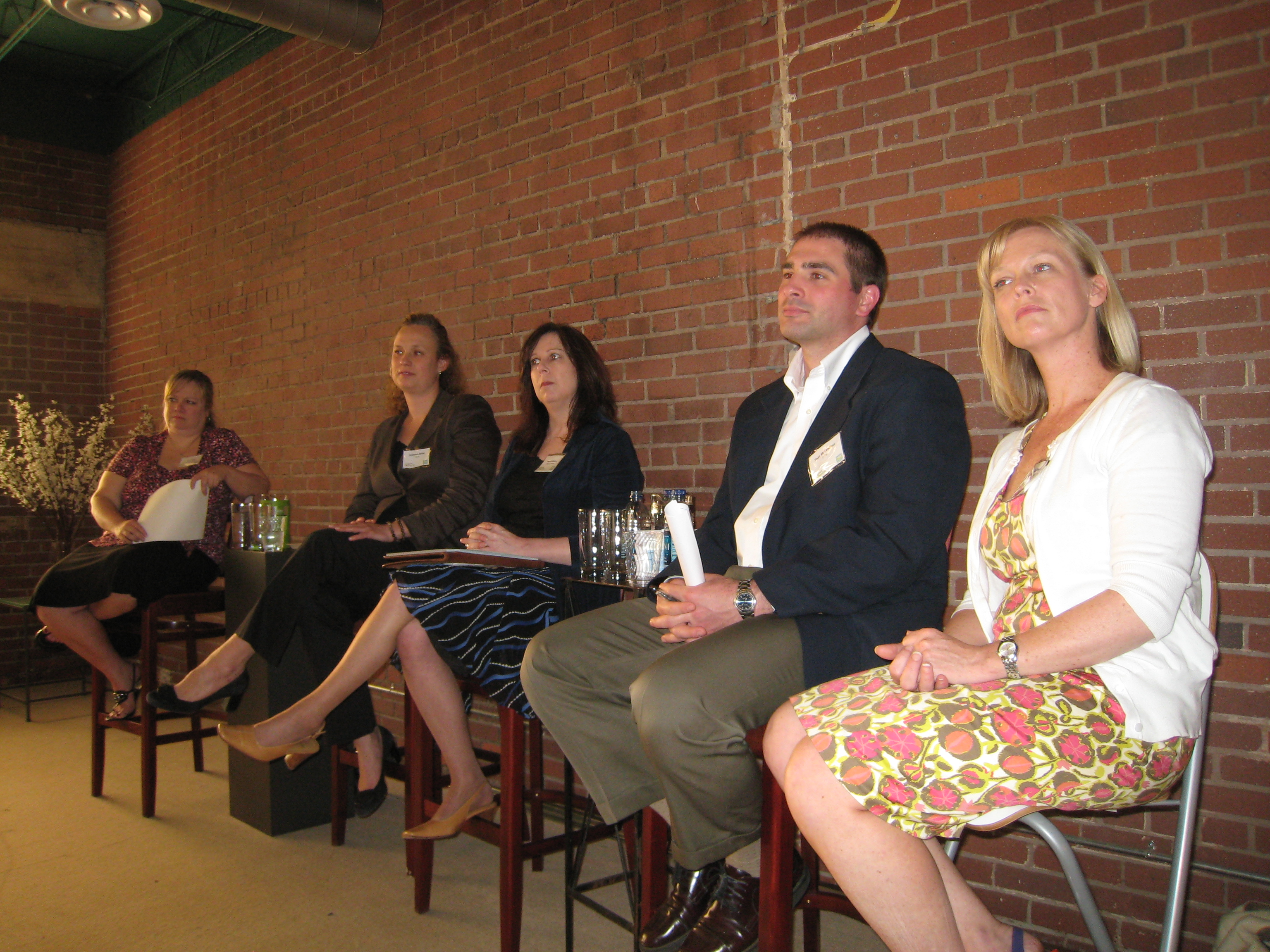
Starting at left, moderator Beth Bond, editor of SoutheastGreen; Gretchen Miller, Vitrue ; Nora DePalma, O'Reilly/DePalma; Sean McCandless, Green Chamber member; and Candace McCaffrey, Cookerly PR

O’Reilly/DePalma principal Nora DePalma participated on a social media panel for members of the Green Chamber of the South last night.  Nora’s Green Earth PR colleague, Nancy Rogers, took notes of the tips, the best of which are listed below:

Facebook

  • Vitrue just finished a study that estimated 3.6 impressions for every fan on Facebook.
  • Rate of posting depends on audience: there is no set schedule that works for all brands.
  • Ask people to fan you; promote it on main website and other sales collateral.
  • Audience skews female.
    • Building products takeaway:  Good consumer play; think female -oriented content.

Twitter

  • Better to retweet and have public dialogues, rather than direct messaging. This helps build followers
  • Engage in conversation by searching for topics related to the brand, and then answer questions or offer advice.
  • Mention others 12x for every one mention of you.
  • Audience skews male. Also a lot of journalists on Twitter.
    • Building products takeaway: Most of our trade press is now on Twitter, along with a surprising number of professionals: plumbers, kitchen & bath designers, and builders.  We almost think of Twitter as a b-2-b play.

Linked In

  • Good place to search for journalists seeking experts
  • Answering questions and posting good articles on the right forums can help establish thought leadership
  • More corporate than other social media channels; more buttoned up and formal language.
  • Audience skews male and c-suite.
    • Building products takeaway: be very mindful of talking more about others than yourself.  Some of the groups are very insightful to read for trend info.

You Tube

  • Second largest search engine after Google.
  • Small “flip” type video cameras are inexpensive and easy for newbies to shoot interviews, testimonials and do fast editing.
  • Speed of editing and posting more is preferred over polished productions.
  • Audience skews male.
    • Building products takeaway:  how-to videos and how-they-work videos do really well.

General Tips

  • Tagging articles on Delicious, Digg and Stumble Upon helps get key messages out to influencers.
  • Cross-promote all digital properties online and in press releases as warranted.
  • Best starting point: a blog. Can even be your website (as O’Reilly/DePalma has done). Gives you an “anchor” for content that can be cross-promoted on Facebook, Twitter, etc.
  • Plan for content and then repurpose it to keep costs and time commitment low.
  • Just do it.  Start with personal accounts and experiment.

The panel was well received, according to Ofra Tessler of the Green Chamber, “Both social media novices and experienced people said it was a great event, they learned a lot, it was interesting, interactive and inspired action.  Everyone said they took quite a few new bits of information back and that it was well worth their time.

“One or two people said this was the best event they had been to on the topic. “

Share and Enjoy:
  • Digg
  • StumbleUpon
  • del.icio.us
  • Facebook
  • Twitter
  • Google Bookmarks
  • BlinkList
  • blogmarks
  • Blogosphere
  • Diigo
  • eKudos
  • Fark
  • Faves
  • FriendFeed
  • Google Buzz
  • Identi.ca
  • LinkaGoGo
  • LinkedIn
  • Live
  • MySpace
  • Netvibes
  • NewsVine
  • Orkut
  • Ping.fm
  • Plurk
  • Propeller
  • Reddit
  • Simpy
  • Slashdot
  • Technorati
  • Tumblr
Apr
1

Architects and Social Media – Archrecord.construction.com

Posted on April 1, 2010 by Nora DePalma

Architects using social media report greater visibility and interest from journalists and peers, according to this article from Architectural Record on architects and social media.

While few firms could point to their social media investment as leading directly to projects, other benefits have emerged, including low-cost networking, talent recruitment, and the ability to use tools such as WordPress to easily update websites. (The O’Reilly/DePalma website is built in WordPress for the very same reason.)

Arch Record cites the architecture firm HOK for being active in social media and using employee-generated content for an artfully designed blog. From there, HOK lists what it calls its HOK Network, links to all of its social media sites listed below:

Mike Plotnick, HOK’s media relations manager, told Arch Record that social media was working better than traditional public relations because their own internal talent was able to present the company directly just being a part of the dialogue about design and architecture.

Read the Arch Record story here.

Share and Enjoy:
  • Digg
  • StumbleUpon
  • del.icio.us
  • Facebook
  • Twitter
  • Google Bookmarks
  • BlinkList
  • blogmarks
  • Blogosphere
  • Diigo
  • eKudos
  • Fark
  • Faves
  • FriendFeed
  • Google Buzz
  • Identi.ca
  • LinkaGoGo
  • LinkedIn
  • Live
  • MySpace
  • Netvibes
  • NewsVine
  • Orkut
  • Ping.fm
  • Plurk
  • Propeller
  • Reddit
  • Simpy
  • Slashdot
  • Technorati
  • Tumblr
National Kitchen and Bath Association Public Relations Society of America: Georgia Green Earth PR Network