Building Products Marketing Insights
- Jan
- 9
Posted on January 9, 2012 by Nora DePalma
The New York Times reports that the monster Consumer Electronics Show (CES) is no longer the dominant launch pad for the hottest new gadgets.
In our industry, neither IBS, nor KBIS are the big launch pads for new products as they once were.
So do we even need trade shows? Our answer is yes, because trade shows bring people together. But does the model need to change in order to support this new raison d’etre for trade shows? We report, you decide:

A really bad trade show.
Comments from designers in a private Facebook group:
Designer #1: I remember having this discussion at IBS last year with somebody from (a major building brand). She commented as we were walking the show floor that the median age at that show was 50 and she was right. Shows that do well recruit younger people and students and offer programming geared to the younger set. Some of the more traditional (and fading) shows just don’t do that and are content to be the equivalent of spring break for middle-aged people.
Designer #2: The last few times I have been to KBIS, I was not impressed really. It was just the same ole same ole stuff. I have continued to attend these traditional shows in hopes of being impressed and continue to be disappointed. I want to be inspired and educated about products in a way that I get a personal connection. With those experiences it allows me to share my inspiration with my clients in a much more meaningful and informed way…I know in my business I feel like I need to be continually changing and evolving to keep current and to take my business to the next level. Needs to be some changes in the traditional trade show, for sure
Designer #3: I think a lot of American shows are still slow moving behemoths. Its a culture that has been around and working for 50 years….People want an experience - an adventure to remember. Pop up events. cross pollination. Imagination fire and ice. Energy that draws down deep and evokes our collective memories from the past that have a certain meaning.
“The show visitor/buyer used to be the ‘audience” based on the ‘if you show something cool, they will come,’” noted Veronika Miller of Modenus, founder of BlogTour, an innovative new model for brands to bring customers together. She continues:
“Trade shows are still important but organizers and exhibitors need to understand that what once was captive audience that was easily wowed…has likely seen the product prior to the show, thanks to something we like to call the “Internet” and may even have some brand/product knowledge already. This means the show has to transition from presentation to interaction and from demonstration to conversation.”
Does this sound like the death of trade shows? Hardly. This same Facebook group notes the power of European trade shows, echoing our POV after attending ISH last March.
Designer #1: All of the larger booths at shows such as ISH, IMM, Cersaie, Salone, etc., have cafes in them. Those booths invite people in to linger, have a cocktail or a snack or what have you and in the process of lingering, the lingerers become a captive audience. They also enjoy themselves and equate fun with the brand that treated them to a sandwich and a glass of wine.
Full disclosure: I worked on the KBIS brand during my tenure at NKBA and it’s a personal passion for me to get this show going again.
In the meantime, I’m going to check out Coverings this year. Kitchen & bath designer and social media pro Paul Anater says to observe the mini villages set up by the Italian and Spanish trade consortia. The Italian pavilion is always set up around a large cafe and they serve breakfast and lunch. The Spanish pavilion is always set up around an amphitheater with seating for at least 50. Paul notes that the ROI of these niceties is selling Italian and Spanish tile by the container full.
I’d also love to see more folks experience BlogTour. Check out the ROI on that.
Let there be fun!

- Jan
- 3
Posted on January 3, 2012 by Joel Williams
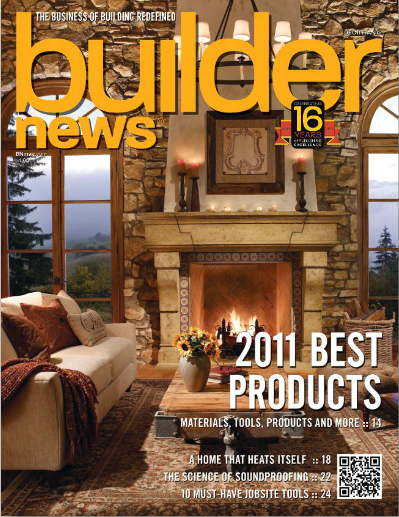 Editors at BUILDERnews Magazine awarded the Uponor Radiant Ready 30E its top prize in the Mechanical category in the publication’s annual “Best Products” competition. The Radiant Ready 30E™ is a complete radiant mechanical room designed in a compact, preassembled, easy-to-install panel. The unit includes a boiler, manifold, pump,expansion tank, pressure-relief valve, isolation valves, thermostat and air vent.
- Nov
- 10
Posted on November 10, 2011 by Nora DePalma
Once we had a solid case study that chronicled Loews Hotels and Resorts’ success using the American Standard Champion 4 toilet to solve the maintenance nightmare of 350 overflowing toilets each month, the pitch came together through serendipity, social media and the inimitable Peter Shankman.
As we were targeting and researching journalists who might find this story beneficial to their readers, we signed up for a Peter Shankman webinar featuring Barbara DeLollis of USA Today Hotel Check-In and the totally hilarious David Moye, pop culture reporter for HuffPost Weird News (former AOL Weird News).
As the Shankman seminar was underway, O’Reilly/DePalma colleagues Joel Williams and Nora DePalma texted between Chicago and Atlanta:
DePalma: Loews case study?
Williams: Yup, on it.
Williams read some of DeLollis’ columns and emailed a succinct and engaging pitch:
“Being naïve to all things hotels, I’d think top hotel chains would be focused on spacious, well appointed rooms, Egyptian cotton sheets and such – not a toilet. Loews and Hyatt, however, think the flush is more powerful than the fluff.”
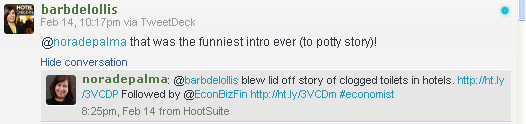
Three days later, DeLollis featured our client in her USA Today Hotel Check-In column. DePalma followed up with some tweet love:
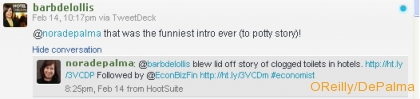
Which led to further mentions:
The Economist Business Travel Blog 2/11/2011
AOL Weird News 2/18/2011
Bayou Renaissance Man Blog 2/20/2011
Discovery Channel Online 2/25/2011
MSNBC 2/25/2011
eHotelier Global Hospitality News 2/21/2011
PM Plumbing & Mechanical 7/1/2011
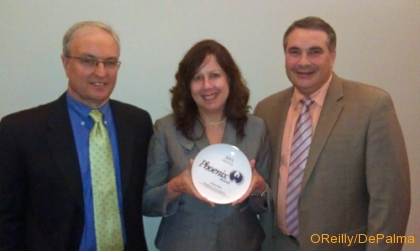
John O’Reilly, Nora DePalma, Joel Williams
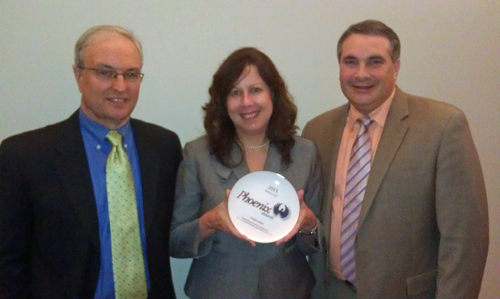
On Thursday, November 3, one of the largest Public Relations Society chapters in the US, PRSA GA, awarded O’Reilly/DePalma and American Standard Brands a Phoenix Award in Feature Writing for this public relations case history about case histories.
To find out how we can tell great stories about your products, email John or Nora.
<<What is a Case Study Part 1
<<What is a Case Study Part 2
- Aug
- 15
Posted on August 15, 2011 by Nora DePalma
The average time spent on a kitchen bath dealer website ranges anywhere from about 43 seconds up to about 2 minutes and 35 seconds, according to Kitchen & Bath Design News columnist, Leslie Hart in the June 2011 issue.
Leslie identifies what every kitchen and bath dealer must provide on their website to give your best sales prospects what they need. Read more at Kitchen & Bath Design News.
- Aug
- 9
Posted on August 9, 2011 by Joel Williams
Circulator pumps were the highlight of this month’s Reeves Journal magazine that featured a case study from global pump and pump systems manufacturer Grundfos. Over the last five years, circulators used for hydronic and radiant heating systems have become more energy-efficient thanks to ECM (Electronically Commutated Motor) technology. The intelligent speed control these circulators provide is drastically reducing energy use without sacrificing performance.
To understand why this technology is so appealing, put yourself in the shoes of plumbing contractor Mike Wolking, who was asked to design a plumbing and hydronic heating system for a custom solar home in south-central Colorado.
In addition to specifying a system that could provide space heating and domestic hot water for the 2,300-square-foot, two-story ranch, Wolking’s design had to consume roughly 40 percent less energy. Read more here.
- Aug
- 1
Posted on August 1, 2011 by Nora DePalma
This is a tale of two companies forging a very different path to profitability: Patagonia and Trader Joe’s. One is a story I heard. The other is a story I Iived.
 Patagonia: At the recent Emerald Circle summit hosted by our wonderful friends at Green Builder Media, one of the most compelling speakers was Patagonia CEO Casey Sheahan. Faced with a recession-generated business slowdown, Sheahan came home one day and told his wife Tara that he thought he would be instituting layoffs.
Tara asked him: “Are you leading from fear or are you leading from love?”
Not a question I suspect a lot of CEOs get. Or consider. Businesses exist to make money, not to help people feel the love. But it made Sheahan stop and think. Did he have alternatives? Had they found all the possible efficiencies? The market would be back at some point. What about the costs of recruiting and training? Eventually, he decided on the following:
• No layoffs, but severely limited raises and no bonuses.
• Direct and honest communications with employees about the decision and the implications.
• Reducing other operating expenses by 20 percent.
Not every job was saved. The reduction in operating expenses meant identifying and terminating the few poor performers. No one likes to tell anyone they no longer have a job, but taking a hard line helped keep everyone else employed.
“Jack Welch was famous for his strategy of focusing on the 5% of employees who were poor performers,” Sheahan said. “I like to focus on the 95% who are good to excellent.”
Results: “Business didn’t just increase. It went through the roof,” Sheahan told us. He said his employees became more motivated than ever, realizing that things could have gone very differently. The resulting loyalty improved both retention and performance.
The good performers were rewarded. The business and Sheahan were rewarded.
Which brings us to Trader Joe’s.
Our son worked at a Trader Joe’s for about a month when he was involved in a horrible accident on his way home from work. Here is the note he sent to Trader Joe’s last month:
Last fall, October 21 to be exact, I fired up my motorcycle and headed on home. Not 5 minutes in to the ride, a car attempting to make an illegal u turn cut from the right lane in to the left and I collided with them. Long story short, I spent 6 weeks in the hospital, and was lucky to be alive.
My crew only knew that I did not show up for work the next day, until one of the EMT’s came by and informed them of what happened.
On my first return visit there was practically a line of people waiting to greet me. I couldn’t believe it. They had only known me for a month, but everyone welcomed me back as if I was family. Genuine feelings and concern were shown by every single person. I have never experienced anything like that before.
As I had only been employed for a month, I did not qualify for any leave. When I returned, my Captain assured me I was welcome to return as soon as I was ready.
I have now been back to work for almost 6 months. I still have various problems that limit me to working 4 days a week, and sometimes force me to leave early. The family here has stepped in every chance they have to help me through the work day.
None of this is shown in the job description or any benefits package. It just goes to show what a company built on simple values can create not just for its customers, but for its employees. The grocery business is about stocking shelves. The TRADING business is about building relationships and maintaining them through consistency, integrity, and apparently, random acts of kindness performed on a regular basis. WOW.
Alex is definitely a performer, a hard-worker with exceptional customer service skills. Trader Joe’s clearly recognizes that. But in a recession, there’s no reason to think they could not have easily replaced him.
They chose to stand by him.
Results: Many of our friends already shopped Trader Joe’s for their unique shopping experience. Now, no one in our circle of friends and colleagues will shop anywhere else, given the choice. More Trader Joe’s business results here.
A brave new world for business? Not for all; some brands will continue to invest in obfuscation to tell their story. Other will invest in government lobbying power to avoid competition.
Others will compete just as fiercely, but—dare I say it?—with love. Because that’s what consumers are increasingly demanding, according to studies like this showing that consumers are taking values into account in their purchase decisions.
It’s the return on relationships. And it works.
- Jun
- 15
Posted on June 15, 2011 by Nora DePalma
Leslie Hart is officially joining us today! Leslie Hart joins O’Reilly/DePalma as a New York-based partner, after several years of project collaboration with us in our building and architecture brand consultancy.
If you’re in the kitchen & bath industry, you know Leslie. The Consumer Insights columnist for Kitchen & Bath Design News and honoree in the Kitchen & Bath Industry Hall of Fame, has more than 30 years of in-depth marketing and communications experience in all channels of the kitchen and bath industry.
Trained as a journalist, Leslie was editor and publisher of Kitchen and Bath Business. That is how we first met when I started in public relations at American Standard in 1989.
Leslie and I worked on the Kitchen Bath Industry Show for several years, with Leslie on the trade show management/publishing side, while I was the marketing director of the NKBA, the association owner of the show.
Last year, we teamed up to produce the new NKBA Kitchen and Bath planners.
Our clients will benefit from Leslie’s brand storytelling skills, as well as her expertise in consumer buying behavior related to kitchen and bath brands. Leslie was director of strategic marketing at Meredith Corporation, publishers of Better Homes and Gardens and other leading consumer magazines, where she created integrated marketing programs for The Home Depot and Sub-Zero, among others.
Read more from the O’Reilly/DePalma press release today.
- Apr
- 7
Posted on April 7, 2011 by John OReilly
After nearly four decades in the building products business, I finally got myself across the Atlantic this winter to the biennial ISH fair in Frankfurt, Germany. Shame on me: I should have made the scene at this grand event many moons ago. There is absolutely nothing in North America that I have come across that even begins to compare.
If you know anything about ISH, even if you’ve never attended, you are probably aware of the scope of the overall fair (11, multi-level buildings); the size and opulence of the exhibits (some of them mini-trade fairs unto themselves); and most of all, the phenomenal crowds cruising its aisles and corridors: more than 200,000 attendees at this year’s event. Upon arriving at the show last month, I found that reality matches all the hype and then some.
But the first thing that hit me about my Inaugural ISH Experience was the high level of hospitality exhibitors happily and freely extended to attendees — great food and lots of German beer (and wine), of course. But also a sheer abundance of… what’s the word? Oh, yeah: FUN. People really seemed to be enjoying themselves.
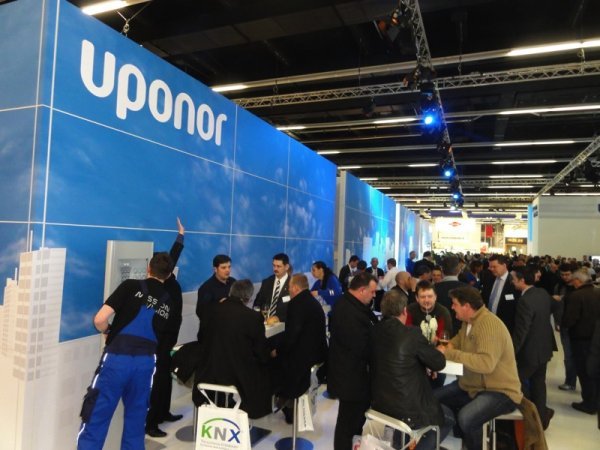
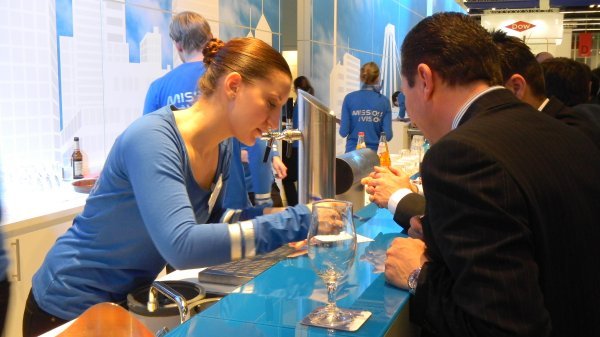
Return on relationships: The sit-down restaurant inside the Uponor booth, where attendees could enjoy beer on tap and something to eat. Uponor was far from the only exhibitor offering this sort of hospitality.
And not just after hours. But right on the show floor, with attendees interacting with interesting brand experiences for literally hours on end. Don’t underestimate the return. “There’s a lot of business going on here,” advised This Old House’s resident plumbing expert Rich Trethewey, whom I encountered at the Uponor booth.
In today’s tight economy, the trade-show budget line item is one of many under intense scrutiny. Yet in some ways, it has always been thus. For as long as I’ve been in this industry, brands have been putting pressure on trade show organizers to demonstrate ROI for their heavy investments in shows, conferences, local meetings and more. “Show me the money!” is an American economic reality that never wanes.
But with trade shows, I fear we have “ROI-ed” the fun out of these events to the very detriment of our business goals. On the fun-o-meter, the typical U.S. trade show ranks a half-notch above a trip to the dentist, a pitiless grind even in good times. How many times have you been through a fast run-through of key messages from a bored booth staffer and on your way in less than 10 minutes, texting friends about where to meet for the REAL fun after 5 p.m.? Where just as much — if not more — business gets done.
It’s a universal truth that we all do business with people we like and like to be around. After attending ISH, pardon me if the whole thing now seems a no-brainer. U.S. trade show exhibitors would do well to think more about booth hospitality along with their key messages. Give people a reason to come in, sit down and stick around a while. Just to talk — with you. Get into real conversations with people, and learn more about them and what they truly want and need.
Figure out how to have a little more fun, and everything else — including ROI — is quite likely to follow. Because having a good time is just as American as making money.
No standing around, gumming a slab of cold pizza for attendees at ISH, where they know how to enjoy themselves and do a little business.
- Jan
- 10
Posted on January 10, 2011 by Joel Williams
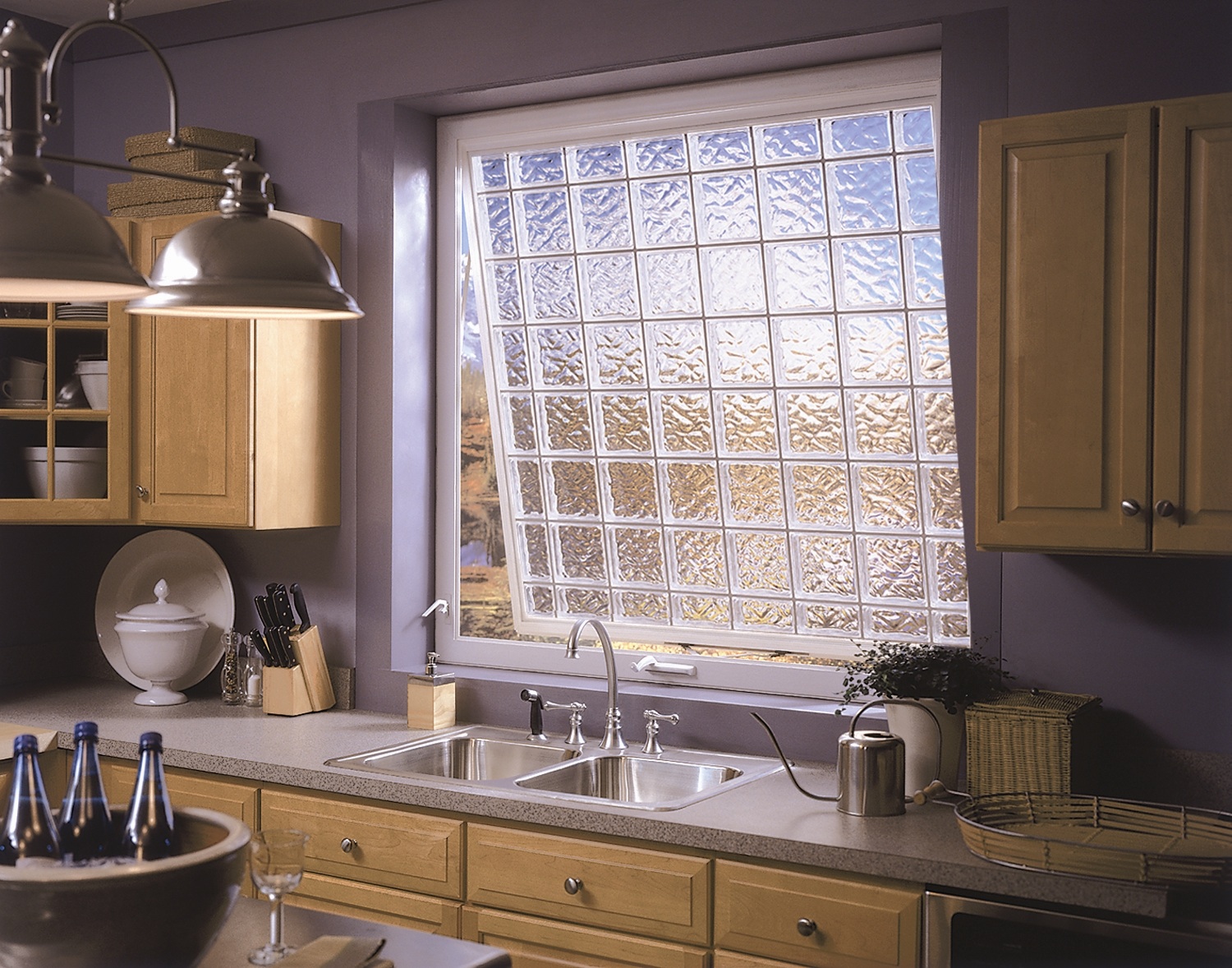
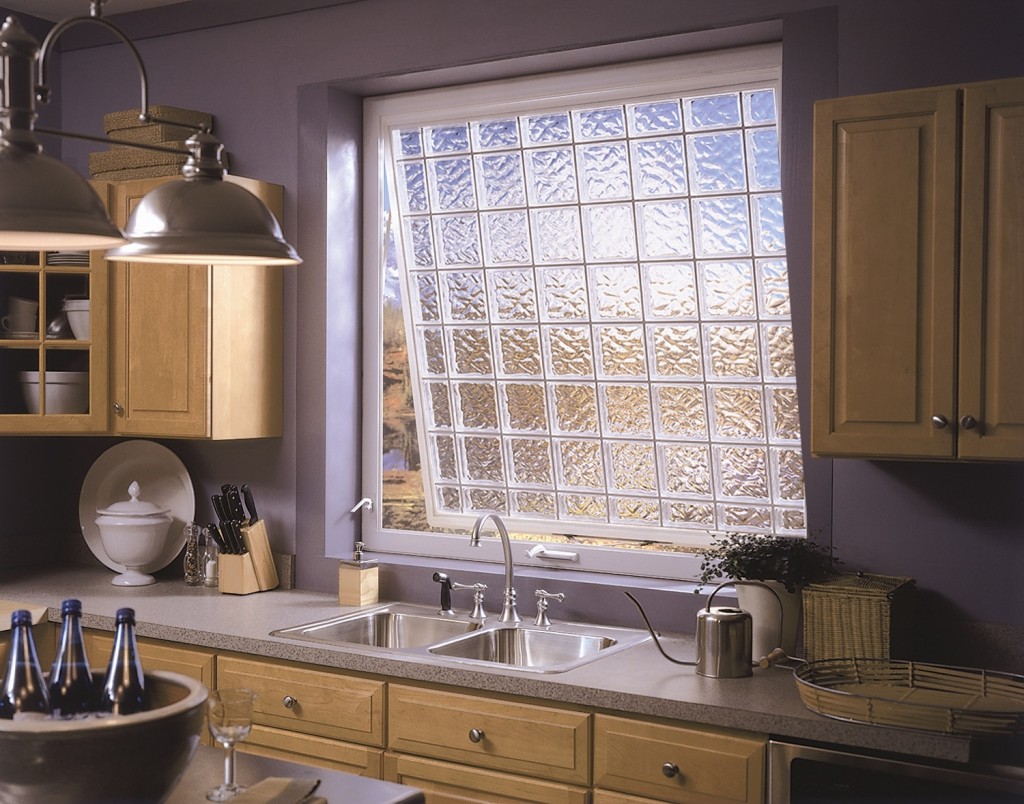 Builder Magazine and A Concord Carpenter highlighted the trend of builders and remodelers increasingly turning to operable acrylic block and decorative glass products from Hy-Lite, a U.S. Block Windows Company, to help add more value, decorative appeal and natural light to a home or apartment renovation.
As the housing market continues its slow recovery, the residential new construction market is seeing a shift in strategy for window openings. Hy-Lite is providing the ideal solution for builders and remodelers nationwide by offering multi-purpose acrylic block and decorative glass windows that make the most out of the ‘less-is-more’ home designs that feature fewer window openings. With these products, builders can preserve the elements that buyer’s value – privacy, natural light and cross ventilation – in high-density-housing configurations without compromising privacy.
- Jun
- 22
Posted on June 22, 2010 by Nora DePalma
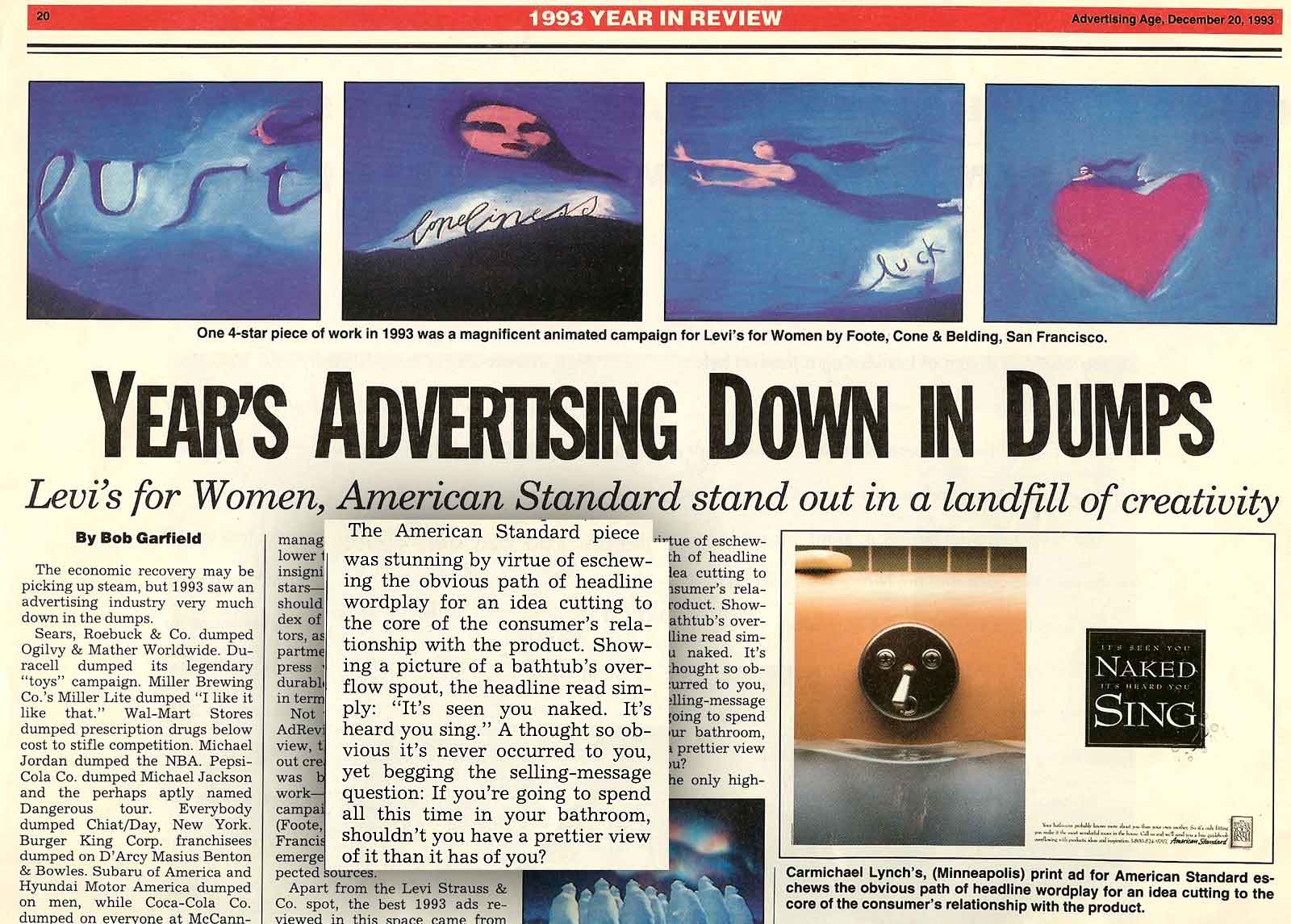
Iconic Advertising Age critic Bob Garfield retired earlier this year after 25 years with the magazine. In his final column, he offered a rundown of the best and worst ad campaigns he saw in his career.
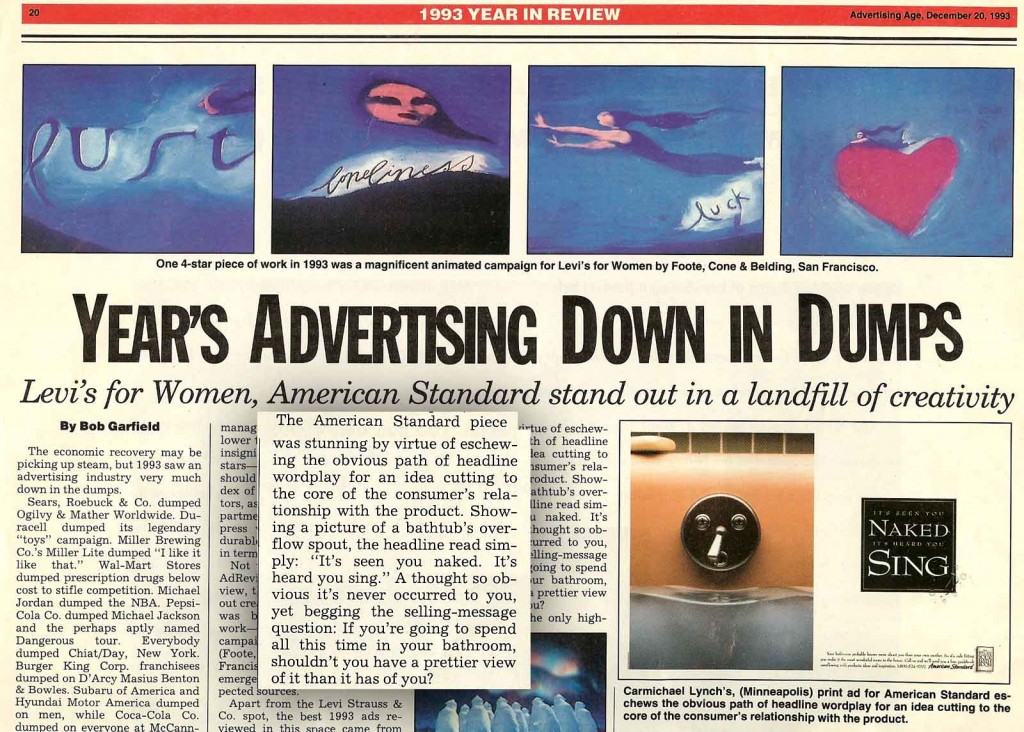 Included amongst the “winners” was American Standard’s 1993 “It’s Seen You Naked” ad, which “subtly anthropomorphized” bath fixtures like faucets and tub drains and featured the copy “It’s seen you naked. It’s heard you sing.”
The campaign was the brainchild of advertising executives Tom Gabriel and Mark Razidlo, now at Gabriel, deGrood, Bendt, who worked closely with the then-Marketing Communications Manager at American Standard, Nora DePalma to develop the ad.
Gabriel’s goal with the campaign was to change the way people thought about American Standard and even about their relationships they had with their bathrooms. “Their competitor owned the luxury position, the ‘house on the hill,’” he explained. “We felt there was another way into the minds and hearts of upscale consumers: to demonstrate that American Standard understands the way we really live…specifically the relationship we all have with this one special room in the house. These days, creating shared connections between brands and their consumers takes different forms, but it’s still all about finding that common ground and evoking empathy and understanding.”
At the time, not everyone was entirely on board with the bold campaign. DePalma remembered that “literally everyone from office peers to my parents hated the ad. But I felt confident in the risk, because I’d seen the research. I knew what our competitors had to spend on marketing and I knew we couldn’t overcome it; we had to go someplace different as a brand to be accepted in consumers’ minds.”
While DePalma and Gabriel were both right in their feelings about the ad, even they weren’t able to predict just how big of a splash the campaign would make. A few years ago, Gabriel saw Bob Garfield at an ad function and was surprised when the critic told him he thought “It’s Seen You Naked” was the best print ad ever done. “At the time, I thought he was pulling my leg,” Gabriel recalled. It turns out that Garfield was definitely being genuine in this compliment.
In equally good news, our Uponor client now works with GdB Advertising, where Gabriel and Razidlo now work. All of us at O’Reilly/DePalma are thrilled to have the opportunity to once again collaborate with with our old friends and look forward to doing more great work together.